PART 5 (Of 5)
The *Obsession * Trigger
HERE'S WHAT WE KNOW
1. Typical character advice does not work for diverse authors writing diverse manuscripts—this is why the character creation sheet you filled out
2. Agents can't empathize with characters who are far removed from their own personal experience
3. Empathy then, must be intentionally engineered, the manuscript written in such a way that The Identity Gap collapses (hint, hint)
If it’s quite difficult for agents to identify with your character, the only way to overcome this bias is to write in such a way that agents identify as your character.
It’s subtle, but this distinction is everything.
It’s not enough for your character to be realistic and sympathetic and three-dimensional. It’s not even enough for them to feel alive.
In order to get an offer of representation, the agent must feel that they ARE your character.
Because you cannot feel estranged from someone you've become.
You see, agents don’t choose novels based on merit or logic. They choose with their gut. The ones they can’t stop thinking about, the ones they binge-read on the subway, and on the toilet, and in bed with the nightlight on at 3am.
When you do this they will see your novel as the only one they want out of the slushpile and practically go to war with each other for the chance to represent you, flipping the power dynamic so agents—multiple—are pursuing you.
This is very simple to do once you have the blueprint, and once it is you’ll be the type of writer that chooses rather than begging to be chosen.
And the blueprint—writing in a way that engineers empathy—is deceptively simple, but difficult to apply.
Let’s drop that definition of empathy again:
Empathy: “the action of understanding, being aware of, being sensitive to, and vicariously experiencing the feelings, thoughts, and experience of another.”
Understanding, being sensitive to, and vicariously experiencing…
Vicariously as being subsumed by someone else’s experience. Experiencing something as if you are that person.
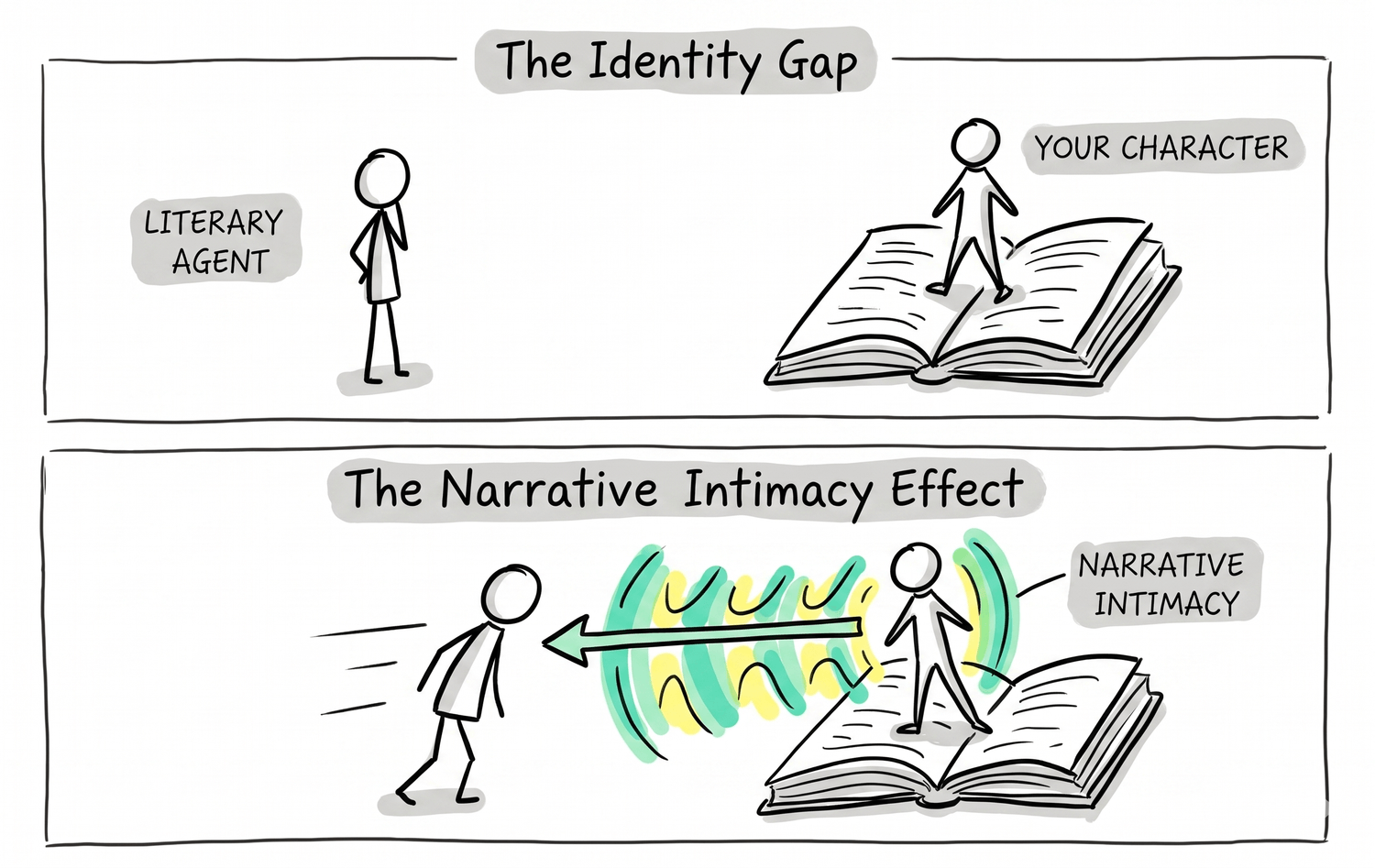
This is the key to multiple offers of representation, stories that sell at auction, debut deals, and viral Booktok fame.
And this—engineering empathy—is something you can do intentionally, through what I’ve named Narrative Intimacy.
This is how diverse authors can overcome The Identity Gap. Rather than asking agents to relate to a character who is nothing like them, we instead blur the lines between reader and character so the agent becomes them.
I first discovered this when I was working at Sterling Lord Literistic, long before I really recognized the power of what I had uncovered or why it worked.
I was working under that one queer senior literary agent on a LGBT+ YA contemporary romance novel. The prose was sharp, the Voice was strong, and the pacing was on-par, but something was missing.
As I read the manuscript I felt distant from the protagonist for reasons I couldn’t quite put my finger on. I was interested in what was happening on the page, but I didn’t feel like I was there, inside the story.
All of my editorial notes, picking apart sentences, and giving example re-writes of paragraphs revolved around that one mission: make me feel like I’m there. Make me feel like I’m him.
I got a pat on the back from the senior agent, was told my notes were insightful and astute and he’d pass them along to the author. I never forgot working on that novel. For years after, it nagged at me for reasons I couldn’t quite name.
There were many novels I saw at the time that I either forgot about, that never made it past submission, or that were published quietly.
Many of them I never got updates on.
So imagine my surprise when, one day, I googled the name of the queer YA romance I had worked on, only to see it was set to be published by Penguin-Random House.
The best part?
I walked into Barnes & Noble a couple months ago, and lo and behold it’s still on the shelves, several years after it was released (always a great sign).
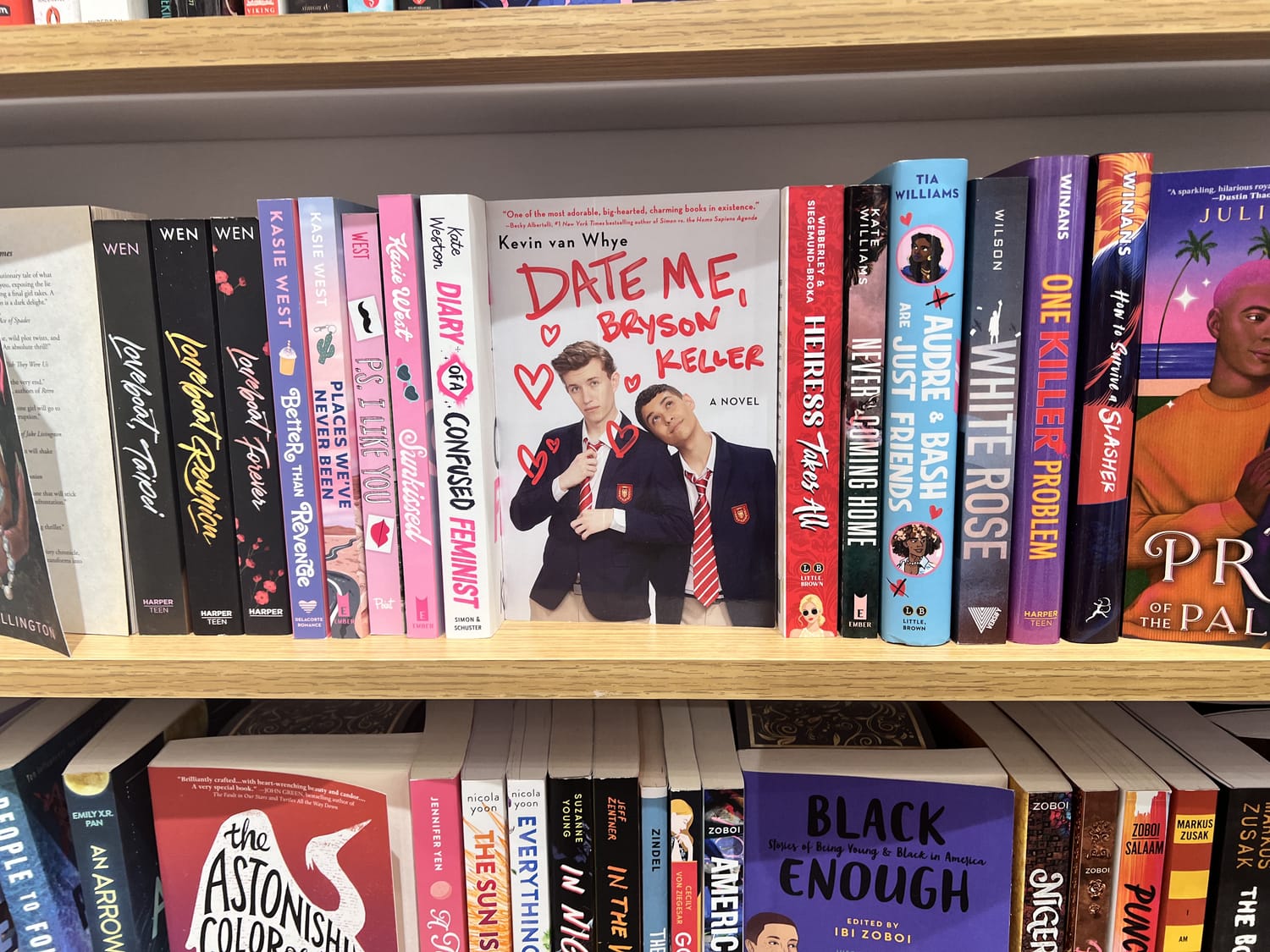
What I was coaching that author in at that time, without really knowing it, was Narrative Intimacy.
And it’s the stuff book deals are made of.
Narrative Intimacy is the thing that makes a story “sticky.” It’s that invisible, intangible, something that grabs literary agents by the throat from the very first page. That makes the difference between rejection and representation.
Between:
“I’ll get back to this later…”
and
reads 163 pages without standing up to pee.
Between:
“I liked it.”
and
“I fell madly in love with it.”
The goal is not to have agents admiring our writing, it’s to get agents to disappear into the story. To, as early as possible, ideally on the very first page, achieve The Vanishing Point: the moment an agent stops being an agent and embodies your character.
They forget they're evaluating. They forget they have seventeen other fulls in their inbox waiting to be read. Because they stopped reading about your character and started living the story as them.
This idea is thoroughly supported by neuroscience. In Story Genius, Cron states:

“According to Jonathan Gottschall, author of The Storytelling Animal, functional MRI (fMRI) studies reveal that when we’re reading a story, our brain activity isn’t that of an observer, but of a participant…The initial job of an effective story is to anesthetize the part of your brain that knows it is a story. That’s why when you’re caught up in a story it doesn’t feel like a story at all; it feels like reality—especially since you’re experiencing what’s happening to the protagonist along the same neural pathways you would if it were actually happening to you.”
Cron, Lisa. Story Genius: How to Use Brain Science to Go Beyond Outlining and Write a Riveting Novel (Before You Waste Three Years Writing 327 Pages That Go Nowhere) (p. 13, 22). Clarkson Potter/Ten Speed. Kindle Edition.
This is achieved by essentially removing the “glass wall” between reader and character. Cutting out the narrator that is telling, explaining, and naming what your protagonist is thinking, feeling and planning, and instead letting their messy, unfiltered sensations and stream-of-consciousness word vomit all over the page.
This is something you really have to see and hear and feel to understand. Below is what you’d find in your typical highly polished, well-written novel. For context, this scene is from an unpublished novel of mine and features Izzy, who has gathered her band of misfits and outcasts for their first rehearsal, preparing for the Battle of the Bands showcase that could win them a record deal. Imagine if it read like this:
Everyone was looking at me as I stood in front of the room. I felt nervous and uncomfortable, which wasn't surprising given that I'd never been in a leadership position before. I wasn't naturally confident like Sky, who had always been the one people looked up to. She had been captain of the JV soccer team, student leader, and co-editor of the literary magazine. Leadership came easily to her in a way it never had for me.
I cleared my throat to calm myself down and addressed the group. I told them we should probably start by deciding on a band name and figuring out what cover song to play for the showcase, and asked if that was okay with everyone.
The room got very loud as everyone started talking at once.
Not bad, not bad at all. I see manuscripts that read like this literally every freaking week.
It’s the type of writing that would earn you a good grade in your MFA class.
But you can feel the Narrative Distance—you’re held at arm’s length from the character as if hovering above them, watching, and there is nothing happening to close the Identity Gap between Izzy, a bisexual black woman, and the agents who’d be reading this who are likely…not that.
Now the same scene, but with Narrative Intimacy:
All eyes are on me, and it makes me hot and a bit itchy. As excited as I am, it’s weird and more than a little uncomfortable, being the one to call the shots. I can’t think of a time I’d ever had that kind of responsibility. Even when I was a teenager and a soloist in the church choir, I was never even considered for a leadership position, despite being the best singer (not to brag on myself, but…it’s true).
When I wasn’t singing, I faded right into the background, Casper-like. It was Sky who everyone always looked up to. She was the captain of the JV soccer team as a sophomore and the de-facto youth group student leader and co-editor-and-chief of the literary magazine and always the one to divide the work in group projects. It comes naturally to her–that unwavering confidence, that firmness in her voice, that magnetism that draws people to her like moths to lantern light and makes them want to listen.
But that has never been me. It still isn’t.
I clear my throat, hoping to dislodge the fist-sized lump tightening it. “Um…well, I–I guess we should start by deciding on a band name. And figuring out what cover song we want to play for the showcase. If that’s…okay?”
The room explodes into sound.
Notice I didn’t have to explain, name, or tell you what type of person Izzy is.
You could feel it. The anxiety, the undercurrent of shame, the sense of imposter syndrome.
And that’s a true sign of Narrative Intimacy—when a rando can describe your protagonist in intimate detail just by reading a couple paragraphs from their perspective.
This is what you need as a diverse author to beat the odds.
SIDENOTE: This isn’t to brag or get high off my own shit. I show you this to show you Narrative Intimacy is a learnable skill, one I’ve been studying (and practicing) for the better part of a decade now.
When you do this correctly and with precision, you induce an involuntary nervous system response in your reader (the agent).
When the character experiences an injustice, the agent will find themselves grinding their teeth, fingers clenching. When the character is in danger, the agent’s stomach will drop, heart jackhammering in their chest. When the character starts getting down and dirty with that smoking hot love interest? You can bet your ass they better feel butterflies, and tingles and warm all over in places they won’t talk about in polite company.
You want every person—from literary assistants to acquisitions teams to ARC readers—who picks up the novel to lose themselves. Lose all sense of time, all sense of space, all sense of self.
This is how you get your dream agent.
Not the agent who will take a hatchet to your writing until it barely resembles your vision. Not the one who loses interest in you if your first book dies on submission. The one who reads your full in one sitting, forgets to eat dinner, and texts her assistant at 11pm because she needs someone to talk to about the gem she just found.
The one who calls you the next morning sounding way too peppy for 5am and maybe a little unhinged, apologizing for calling so early, and then immediately asks what else you've been working on — because she already knows she will love anything and everything you’ve written.
Not just any agent. But the right agent.
That agent exists. She's out there right now, reading someone else's manuscript, waiting for yours.

I'm not going to pretend Narrative Intimacy is easy. It's a real skill, with real technique behind it — not a vibe, not luck, not "good writing.” I've spent the better part of a decade studying it, teaching it, and still occasionally fumbling it in my own drafts.
You could try to figure this out entirely on your own. Some of you will. Genuinely — I hope it works.
But if you're tired of revising the same manuscript for the fourth time with no idea whether it's actually better or just different —
If you're tired of R&Rs from agents who can sense something's missing but can't tell you what —
If you're done gambling your one shot at this book on trial and error —
I built something. For people exactly like you.
It's called OPUS Authors. Our Powerful, Under-Represented Stories.
Cheesy? Absolutely. Needed? I'm betting my career on it.
It is not a course. It is not a Facebook group where your query letter disappears into the void, buried by 10 other posts. It is a room full of diverse authors who have lived exactly what you're living right now, walking this with you until you're the one getting that midnight email offering representation.
Here's the part I need to be honest with you about:
I'm not opening this to everyone.
Not because I don't want to help everyone — I do. But because what I built only works if the people inside it are as serious, as hungry, and as ready as you are right now, reading this at whatever hour it currently is, still awake, still in this.
So here's what's going to happen.
In my next email, I'm going to tell you exactly what OPUS actually looks like on the inside — and exactly how someone gets considered.
Some of you are going to read that email and immediately know it's not for you. That's fine. That's the point.
But if you're the person I think you are — the one who's shelved a manuscript she loved and still isn't done fighting, the one who rereads her own rejection folder looking for patterns instead of just crying about it (well. Both. Both is good too) —
Then keep an eye on your inbox.
Because what's coming next isn't something I'm going to say twice.
SUBTEXT
1. This is why the advice of that developmental editor, those beta readers and critique partners, have not worked to get you representation—because perfect pacing, beautiful prose, and a strong hook may help the reader identify with the character but not as the character
2. When you know how to decode agent-speak, they will often point you to exactly what you need to fix. Even the vague "I didn't fall in love" rejections are insightful when you peel back the layers. This is half the battle.
3. Narrative Intimacy has to work on two levels—emotional and somatic. What you feel, and what you feel (literally, in your body). Miss one and the whole thing falls flat (hint, you're probably pretty decent at one and almost completely missing the other)
Want to keep reading?
This next part is proprietary intellectual property. Which is a fancy way of saying it's my top-secret, mind-blowing brain baby, and I only want it in the right hands. If what you've read so far has resonated with you, put in your name and email below and I'll email you the rest of the series.
We HATE spam. Your email address is 100% secure and I will literally only email you to give you more cool shit like this article series. Unsubscribe anytime. I won't cry (maybe a little).